

Dear readers,
There’s a saying that goes, “The only constant in life is change,” and few communities know this better than those of us working in IT and computer science. Work at SCC is consistently characterized by the implementation or research of large and small changes with the aim of improving efficiency, usability, performance, scalability, sustainability, and security.
In high performance computing, entirely new systems are typically procured and built every five years – precisely when more advanced, faster, and more energy efficient technologies become available and the operating costs of the existing machine are no longer sustainable. That point will be reached in 2026 for the "Hochleistungsrechner Karlsruhe" high performance computer HoreKa. It will be succeeded by HoreKa 2, and the data center housing it will be expanded accordingly to support the required
performance class (p. 20).
As part of the network modernization, particular attention is being paid to ensuring that the new systems support comprehensive, network wide collection of high resolution telemetry data (p. 8). This makes end to end monitoring possible, simplifies troubleshooting and error resolution, and ultimately increases the operational stability of the entire network.
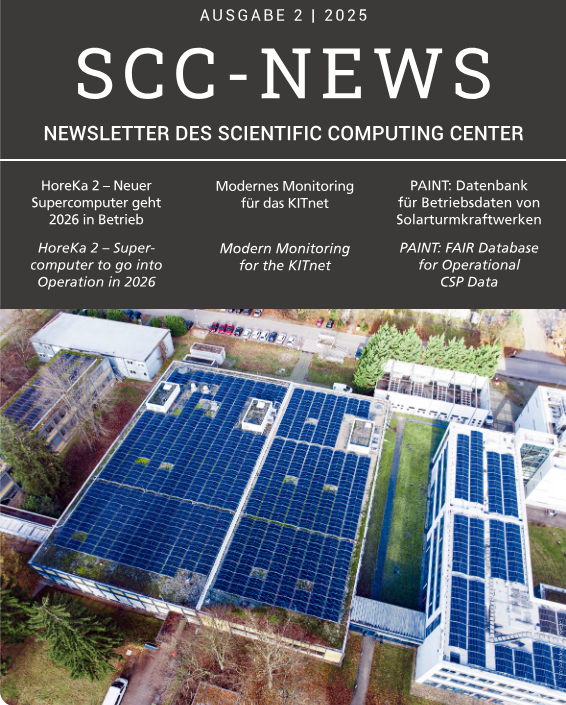
Sustainability plays an important role for us in this regard – for example, in large infrastructure projects such as HoreKa 2, the installation of solar panels on SCC buildings (cover page, p. 53), and in research projects such as the development of modern power plants for renewable energy. Researchers describe in a humorous and down-to-earth manner, using the local Baden dialect and Australian Bogan style, how the first FAIR open-access database for operating data from solar tower power plants is helping to bring this technology from the research demonstrator stage into practical use (p. 46).
Enjoy reading!
Martin Frank, Martin Nußbaumer, Achim Streit