

SDL Materials Science
Materials science simulations face domain-specific challenges related to the extreme heterogeneity, diversity and complexity of materials data and models. An additional challenge is to extend the limits of state-of-the-art methods in terms of scalability, improving the numerical complexity and supporting the portability of high performance codes between different computer architectures, as well as enhancing the exploitation of existing data modeling and scalability frameworks by domain scientists. The main goal of the Simulation and Data Life Cycle Lab Materials Science within the “Engineering Digital Futures” program in Research Field Information of the Helmholtz Association is to bring together existing high performance computing, data science and software engineering methods to develop a tailored approach to address these domain-specific challenges through research and support in equal measure.
i2Batman
Together with partners at Forschungszentrum Jülich and Fritz Haber Institute Berlin, our goal is to develop a novel intelligent management system for electric batteries that can make better decisions about battery charging cycles based on a detailed surrogate model ("digital twin") of the battery and artificial intelligence.
Contacts: Hasan Kalkan, Dr. Ivan Kondov
Joint Lab MDMC

Within the framework of the Joint Lab "Integrated Model and Data Driven Materials Characterization" (MDMC), the SDL Materials Science is developing a concept for a data and information platform to make data on materials available in a knowledge-oriented way as an experimental basis for digital twins and for the development of simulation-based methods for predicting material structure and properties. It defines a metadata model to describe samples and datasets from experimental measurements and harmonizes data models for material simulation and correlative characterization using materials science vocabularies and ontologies.
Contacts: Dr. Rossella Aversa, Prof. Dr. Achim Streit
Joint Lab VMD

The SDL Materials Science develops methods, tools and architectural concepts for supercomputing and big data infrastructures, which are tailored to tackle the specific application challenges and to facilitate the digitalization in materials research and the creation of digital twins. In particular, the SDL develops a virtual research environment (VRE) that integrates computing and data storage resources in existing workflow managements systems and interactive environments for simulation and data analyses.
Contact: Dr. Ivan Kondov
Details: Virtual Materials Design (VirtMat)
NFDI4Chem

NFDI4Chem (National Research Data Infrastructure for Chemistry) is a German initiative dedicated to establishing a sustainable, FAIR-compliant (Findable, Accessible, Interoperable, and Reusable) data infrastructure for the field of chemistry. Its objective is to improve the management, dissemination, and reuse of chemical research data across disciplinary boundaries within the scientific community. By engaging chemists, data scientists, and relevant stakeholders, NFDI4Chem supports the creation of tools, standards, and best practices designed to optimize data handling processes throughout the entire research lifecycle, thereby enhancing data accessibility and collaboration.
Contact: Peter Krauß, Doris Ressmann
Details: Projektwebseite
NFDI4Ing
NFDI4Ing is an engineering consortium which promotes the management of technical research data. The consortium offers a unique method-oriented and user-centered approach to make technical research data FAIR (Findable, Accessible, Interoperable, Reusable). An important challenge is the large number of sub-disciplines in engineering and their subject-specific peculiarities. As part of NFDI4Ing, the SDL develops and implements the concepts for federated research data infrastructures, data management processes, repositories and metadata management in close cooperation with its partners.
Contact: Prof. Dr. Achim Streit
Details: Project Website
NFDI-MatWerk
The NFDI-MatWerk consortium is focused on the development of a knowledge-graph-based joint infrastructure for Materials research data. NFDI-MatWerk stands for Materials Science and Engineering to characterize the physical mechanisms in Materials Science and to develop resource-saving high-performance materials with the ideal properties for the respective applications. The SDL will work with the project partners to set up the Digital Materials Environment with the infrastructure services for research data and associated metadata.
Contact: Prof. Dr. Achim Streit
Details: Project Website
NFFA-Europe Pilot (NEP)
The NFFA-Europe Pilot (NEP) project provides access to facilities and resources for research at the nanoscale. In the project, the SDL contributes with new methods for metadata enrichment, innovative data and metadata management technologies, the development of large data collections, and the provision of virtual services to the establishment of a joint research data infrastructure.
Contact: Dr. Rossella Aversa
Details: Project Website
NHR

Within the National High performance Computing (NHR), the SDL Materials Science provides high-level support for the materials science community and conducts joint research and development. Here, the SDL will serve as a connective link to HPC operations, HPC methods development and computational materials science community.
Details: Project webpage
RTG 2450 / GRK 2450
This research training group of the DFG is focused on tailored scale-bridging approaches to computational nanoscience. The team from SDL Materials Science works to support doctoral researchers adopting novel methods and tools for workflow development and parallel multiscale computing.
Contact: Dr. Ivan Kondov
SDC MoMaF

The Science Data Center Molecular Materials Research (MoMaF) brings together core competencies in the field of research data management and data analysis for research areas ranging from chemistry to materials science. These cover the areas of software development, as well as analysis, provision and preservation of research data dealing with molecules and their interactions for the description of materials.
Details: Project webpage
VM-FIRE
Modern research increasingly depends on computational methods, making adherence to the FAIR principles (Findable, Accessible, Interoperable, Reusable) essential for transparency, reproducibility, and long-term usability. The VM-FIRE project tackles this challenge by evolving the VirtMat Tools software suite—originally designed for materials science—into a versatile, user-friendly platform for simulations across disciplines. VM-FIRE’s mission is to lower barriers to reproducible and efficient research while ensuring accessibility for users without deep computational expertise. In collaboration with the Jülich Supercomputing Center, the project will introduce key technical enhancements such as checkpointing, restart capabilities, modularization, and improved data storage. It will also strengthen compliance with FAIR and FAIR4RS principles by refining metadata and integrating persistent identifiers. Beyond technical improvements, VM-FIRE emphasizes community building. Through workshops, tutorials, and collaborative channels, the project aims to create an active user-developer ecosystem that drives adoption and continuous innovation. Finally, deploying VirtMat Tools at a Tier-1 high-performance computing center will showcase its scalability and interdisciplinary potential—supporting the Helmholtz Association’s vision of sustainable research software that fosters scientific innovation and knowledge transfer.
Contact: Dr. Rodrigo Cortes Mejia, Dr. Ivan Kondov
VirtMat Tools
VRE-Language: A family of domain-specific languages and supporting tools for scientific computing, materials modeling and data analysis
VRE-Middleware: CLI, GUI and Python API for a platform consisting of HPC clusters with resource management system Slurm, workflow management system FireWorks, and MongoDB database
Contact: Ivan Kondov
Further information: The software project webpage
ArFlock

ArFlock is a C++ program library ArFlock providing attractive and repulsive Particle Swarm Optimization (PSO) algorithms, different update rules, different models for the inertial weights, neighborhoods, and various velocity and search space constraints, such as periodic boundary conditions. Synchronous and asynchronous parallel PSO implementations are available and optimized for use on massively parallel machines.
Contact: Ivan Kondov
Details: www.scc.kit.edu/en/research/arflock
NAStJA
The NAStJA framework provides an easy way to enable massively parallel simulations for a wide range of multi-physics applications based on stencil algorithms. Applications including CellsInSilico for tissue development, phase-field method and phase-field crystal model for material science.
Contact: Marco Berghoff, Nikolai Pfisterer
Details: gitlab.com/nastja/nastja
NAStJA Viewer
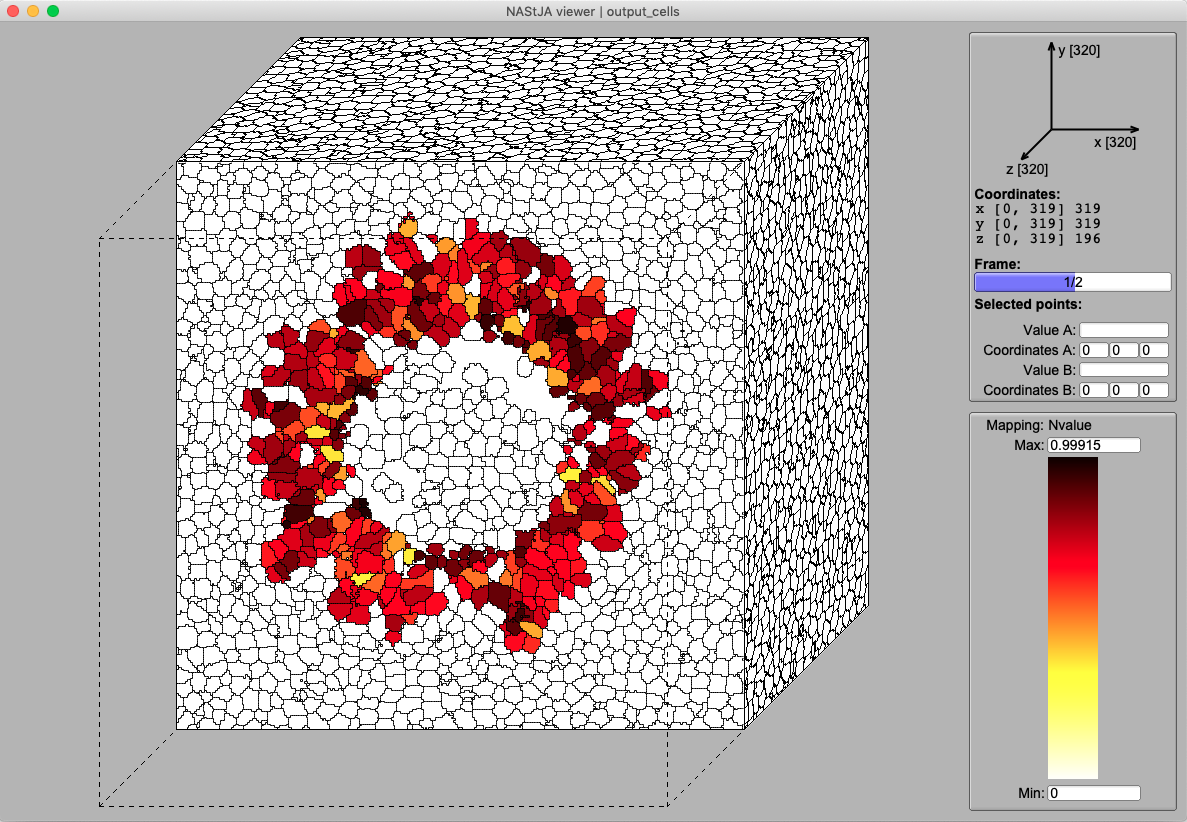
A small and fast open source visualization tool for 3D image data. Perfect for a fast look into simulation data. Just open the files and sweep around. A complicated setup of various filters is unnecessary. It supports NAStJA‘s output files and beyond other file formats it is easily extensible.
Contact: Marco Berghoff
Details: gitlab.com/nastja/viewer
| Name | Tel. | |
|---|---|---|
| Dr. Kondov, Ivan | +49 721 608-28644 | ivan kondov ∂does-not-exist.kit edu |
| Name | Tel. | |
|---|---|---|
| Dr. Aversa, Rossella | +49 721 608-28546 | rossella aversa ∂does-not-exist.kit edu |



 286

